Learn how to recognize the signs of soil compaction, understand when vertical mulching may help, and discover the research behind Read more
Why do some fruit trees thrive while others struggle?
Why will one fruit tree take off while another, planted around the same time, seems to struggle?
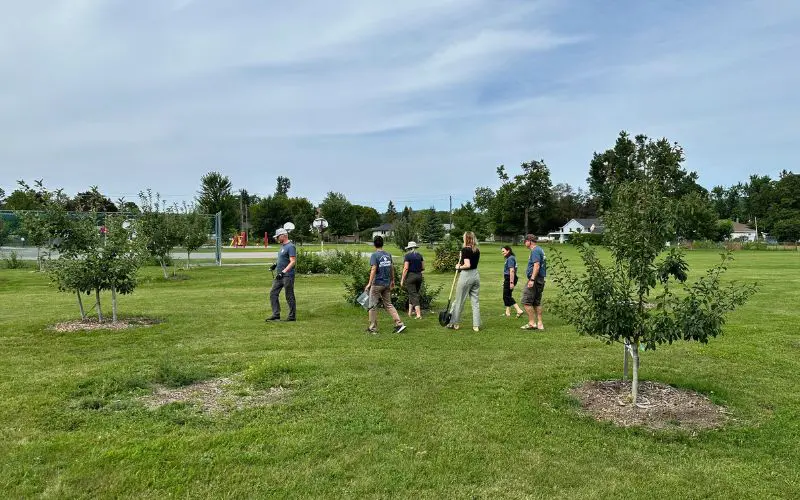
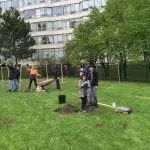
That was the mystery waiting for us when I recently visited two community orchards in Peterborough, Ontario, managed by GreenUP, an environmental organization working to create healthier, more sustainable communities.
I explored the orchards with Christina Balint of GreenUP, who works with the community orchard program and the volunteers who care for these trees. At the Keith Wightman Community Orchard, the fruit trees looked healthy and vigorous. At the Reid/McDonnel orchard, trees planted around roughly the same time were noticeably smaller.
There could be many reasons for that difference. And we wondered: could part of the answer be hiding beneath our feet?
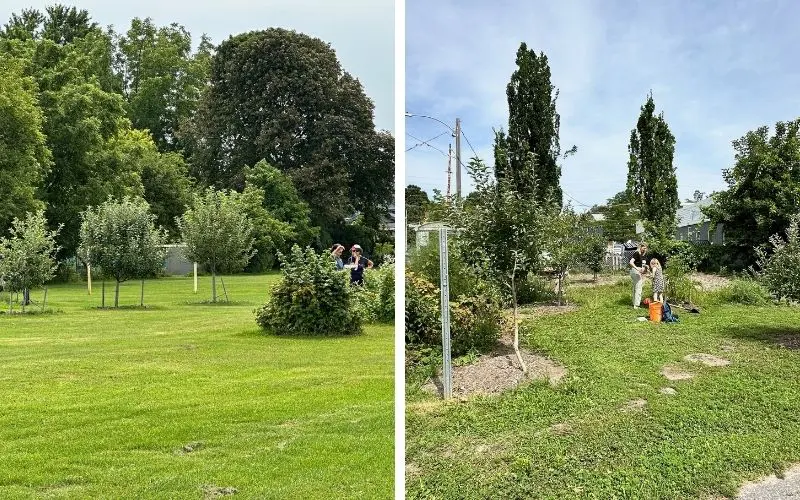
So we collected soil samples from both orchards and sent them to soil microscopy expert Derek Barbe. Derek joined Christina and me on the Orchard People Podcast to explore what was living in those soils—and what those results might tell us about the trees.
What we found didn't solve the mystery neatly. It gave us another set of clues and reminded us that when a fruit tree isn't thriving, there is rarely just one thing to investigate.
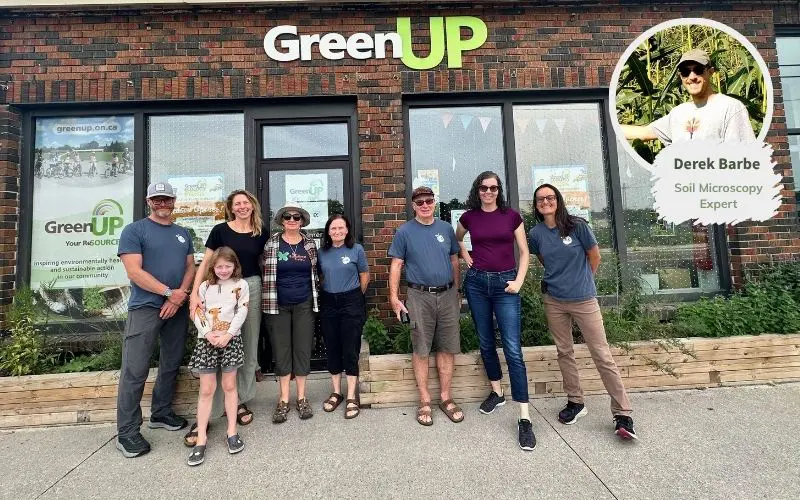
By the way, this is a quick summary of an Orchard People podcast. We’ve pulled out the highlights to give you a taste of the conversation—but there’s so much more in the full episode. Scroll down to watch or listen and hear the full story in context.
When a fruit tree isn't thriving, start by looking at its growing conditions
It's tempting to see a small or struggling fruit tree and immediately wonder what we should give it. Does it need fertilizer? More compost? Some sort of soil amendment?
Those may be useful questions. And before adding anything, take some time to look at the conditions the tree is already growing in.
Is grass growing close to the tree and competing for water and nutrients? Is the soil hard and compacted? When it rains, does water soak into the soil or sit on the surface? How large is the mulched area? If you push a shovel or garden fork into the ground, does the soil crumble or feel like a solid block?
Compaction is particularly important because healthy soil contains pore spaces that allow air and water to move. Dense, compacted soil can restrict root growth, change drainage and reduce the oxygen available to roots and many soil organisms.
Compacted soil can make it difficult for roots, water, and air to move through the ground. If you suspect compaction is part of the problem, our article on vertical mulching for fruit trees explores one approach to improving those conditions.
Those observations give you one set of clues. In Peterborough, we added another by looking at the soil under a microscope.
Soil biology adds another layer to what we can learn about fruit tree health
A conventional soil test looks primarily at soil chemistry and can tell us about things like pH and nutrient levels. Soil microscopy asks another useful question: who is living there?
Derek examined our samples for bacteria, fungi, protozoa and nematodes. Together, these organisms form part of the soil food web, the living community that helps break down organic matter and cycle nutrients.
Fruit trees participate in that relationship. Their roots release sugars and other compounds called root exudates, which feed microorganisms living around the roots.
“They form a mutual relationship with plants,” Derek explained. “It’s symbiotic.”
As microorganisms feed, reproduce and die, nutrients held within that biological system can become available to plants. A chemical soil test can help us understand the nutrients and characteristics of the soil, and microscopy can offer another view of the biological community involved in nutrient cycling.
If you're curious about the process itself, our introduction to soil microscopy for fruit trees explores the organisms Derek was looking for and what they do.
At the healthier-looking Keith Wightman orchard, Derek found plenty of bacteria and very little beneficial fungal biomass. The Reid/McDonnel orchard - the one with the smaller trees - actually had more fungal biomass, and it also had a much larger bacterial population.
In Derek's microscopy framework, woody perennial plants such as fruit trees are generally associated with soils containing a stronger fungal component than soils dominated by grasses and annual plants.
So our experiment didn't produce a simple “healthy orchard versus unhealthy orchard” result. Instead, it gave us more questions to consider.
Soil biology was part of the story, and so were water, compaction, grass competition, root conditions, past management and ongoing care.
Fungi, bacteria and nematodes each tell us something about fruit tree soil
You don't need to become a soil microbiologist to grow healthy fruit trees. And knowing a little about the organisms beneath them can change how you see the soil you're caring for.
Under the microscope, beneficial fungal hyphae look like tiny threads. These strands extend through the soil and form part of the underground network involved in decomposition and nutrient cycling.
Derek also showed us tiny soil microaggregates—particles of soil and organic matter held together partly by substances produced by microorganisms. He described them as little “castles.” These small aggregates contribute to larger soil structure and the pore spaces that allow water and oxygen to move.
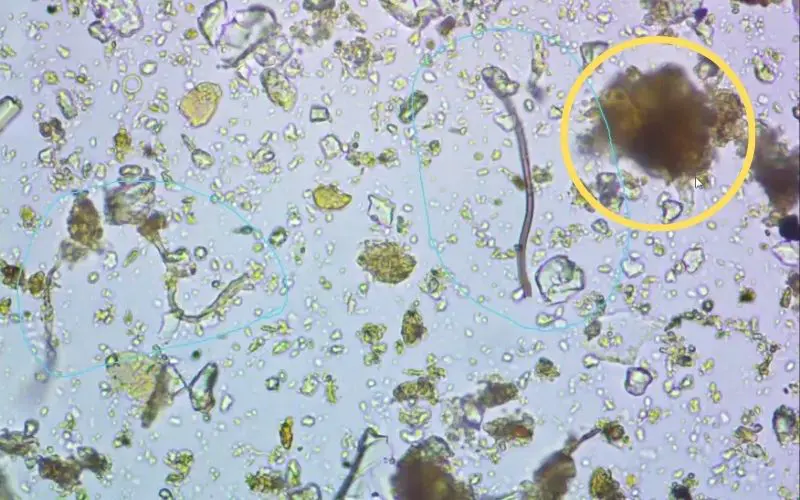
Then there are nematodes, microscopic roundworms that can play very different roles. Some feed on plant roots and can damage plants. Others feed on bacteria or fungi, while predatory nematodes eat other organisms. Derek found bacterial-feeding nematodes in our samples, which can contribute to nutrient cycling.
So nematodes can be part of a healthy soil food web and some types can be fruit tree pests. What matters is which nematodes are present and what they eat.
If you'd like to explore that further, our article on beneficial nematodes explains how certain species can also be deliberately used to control fruit tree pests.
Good compost and mulch can support the living environment around fruit tree roots
When I asked Derek how growers could encourage beneficial soil organisms, his first recommendation was straightforward: good compost.
“The best way to get beneficial organisms onto your plots of land is to get compost and apply that compost,” he said.
That can mean spreading well-made compost over the soil or using a simple compost extract, where quality compost is mixed with water and the resulting liquid is applied around the root zone.
And the quality of the starting material matters.
“You’re only as good as your compost,” Derek said.
Derek suggested good-quality compost or vermicompost—compost made with the help of worms—as possible sources of beneficial organisms. Once beneficial fungi are present, organic materials such as wood chips can provide food that helps support them. He also mentioned fish emulsion and fish hydrolysate as possible fungal foods.
Christina described another interesting experiment at GreenUP. In a Miyawaki-style mini-forest planting, they removed grass, added compost and then covered the ground with partly decomposed leaf litter in an effort to mimic some of the conditions on a forest floor.
There are different ways to nurture soil life. The common thread is creating better habitat around the roots rather than thinking only about feeding the tree itself.
Compost and mulch can improve the environment around fruit tree roots, and water is another important part of that relationship. Our conversation with Casey Clapp explores why watering and feeding fruit trees are so closely connected.
Expand the mulch circle as your fruit tree grows
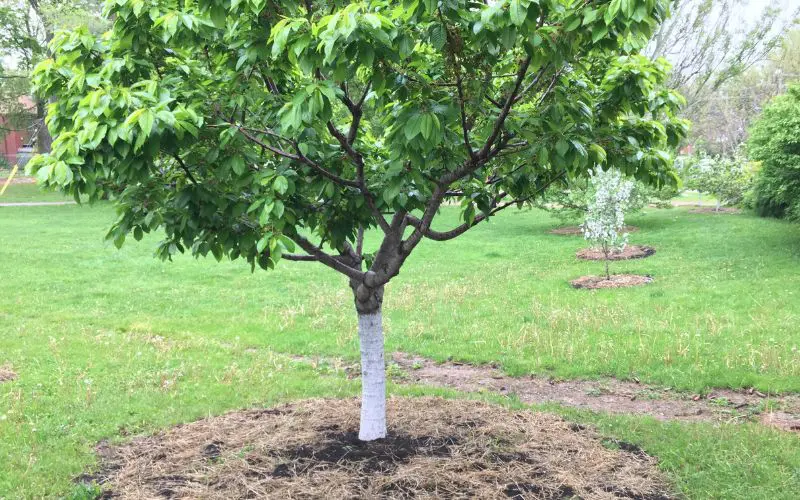
One of the simplest ways to improve that habitat is to rethink the little mulch ring around a fruit tree.
Sometimes we make a small circle when the tree is planted and leave it that size forever. The tree grows, and so does its root system.
As roots spread outward, many of the fine roots involved in water and nutrient uptake are found farther from the trunk. So the mulched, grass-free area can expand along with the tree.
Pull competing grass back, spread compost over a broader portion of the root zone, and cover the soil with organic mulch such as wood chips. Keep compost and mulch from piling directly against the trunk.
I've seen what years of this kind of care can do at our own community orchard at Ben Nobleman Park. When we started, the soil was hard clay and we saw very few earthworms. Each year we spread about two inches of compost around the trees and maintained the mulch circles.
Years later, while working beneath those trees, I couldn't believe how many worms I found.
There's hope.
Soil improvement can be slow, and slow change can still be meaningful change.
Soil tests provide useful information, and sampling location affects what they reveal
Our Peterborough experiment also taught us something about testing itself.
We collected samples from different areas of the orchards rather than focusing entirely on the soil influenced by the fruit tree roots. Derek suggested that if we wanted to understand the biological community associated with a particular tree, we should focus more closely on its rhizosphere.
The rhizosphere is simply the area of soil directly influenced by living roots. That's where roots release exudates and where microorganisms can become concentrated because the roots are feeding them.
Soil microscopy can provide useful information, and where you collect the sample shapes what you may discover. Conventional soil tests offer another perspective, helping growers understand characteristics such as pH, organic matter, and nutrient levels. Our guide to reading a soil test for fruit trees explores how to interpret those results alongside what you're observing in the orchard.
That's not a reason to dismiss testing. It's a reason to interpret the results in context.
Grow
Fruit Trees
That Thrive
Fruit Trees
That Thrive
Sign up for our newsletter and get this free eBook
Sign up for our newsletter and get this free eBook
Fruit trees thrive through science, observation and ongoing stewardship
By the end of our conversation, Christina brought us back above ground.
When she first became involved with GreenUP's community orchard work, she thought the orchards might be relatively hands-off. Over time, she realized how much ongoing care they actually need—and how important volunteers, education and resources are to their success.
One GreenUP volunteer, Quentin, suggested having a core group of knowledgeable orchard stewards who can guide other volunteers. Everyone doesn't have to become an expert. A smaller group can develop deeper knowledge and help others participate successfully.
That's just as true when you're growing one or two fruit trees at home.
You can learn from science and from the tree in front of you. Look at its growth. Notice the soil. Check for compaction and drainage. Reduce competition from grass. Widen the mulch circle as the tree grows. Add good compost and organic mulch. And when something still doesn't make sense, keep investigating.
Perhaps that's the most useful lesson from our Peterborough orchard mystery.
The healthier-looking orchard didn't have a perfectly healthy soil biology report. The smaller trees weren't explained by one number on a test. Instead of giving us one answer, the investigation gave us a fuller picture.
Listen to the podcast for more info and to hear Derek, Christina and the GreenUP orchard volunteers explore what these two orchards taught us.
Fruit tree care is a relationship. Science can help us understand that relationship, and observation helps us understand the particular tree growing in front of us.
So when a fruit tree struggles, we can ask more than, “What should I add?”
We can also ask:
What am I seeing? What can I learn from it? And what conditions can I improve?
Continue learning with our guests
Christina Balint and GreenUP
The orchards featured in this story are part of a larger network of community orchards cared for by volunteers with support from GreenUP and community partners. Learn more about the Peterborough Community Orchard Stewards and read Christina Balint's story about how these orchards are growing more than fruit.
For those in the Peterborough area interested in taking part, GreenUP also shares volunteer opportunities. Those interested in helping sustain GreenUP's work can also support GreenUP with a donation.
Derek Barbe and the Soil Food Web
For those interested in exploring soil biology further, Derek recommends the Soil Food Web Certified Listing Directory, where you can find a Soil Food Web practitioner near you.
For those interested in going deeper, Derek also recommends this Soil Food Web resource featuring Dr. Elaine Ingham on YouTube, founder of the Soil Food Web School.
Listen to the full podcast here


Susan Poizner
Award-winning author, podcaster, fruit tree care educator and creator of the fruit tree care education website OrchardPeople.com. Learn more about Susan on the about us page.
YOU MAY ALSO BE INTERESTED IN
Vertical Mulching for Fruit Trees: When Surface Mulch Isn't Enough
When to prune fruit trees
Wondering when to prune fruit trees? In this blog, we explore which trees benefit most from winter pruning and when Read more
When to Plant Bare Root Fruit Trees?
When to plant bare root trees? The best time to plant bare root trees is in the spring or fall Read more

Bush Cherry vs Dwarf Cherry Tree: Best Picks for Your Small Garden
Dwarf cherry tree, or cherry shrub: which is a better choice for your small garden?