From their vivid color to their complex flavors and growing conditions, red fleshed apples invite us to look more closely Read more
Fertilizing Fruit Trees: Why Water Matters More Than You Think
Watering and feeding fruit trees might seem like two separate jobs, but inside the tree, they’re closely connected. For instance, you might fertilize your fruit tree and notice it’s not responding well. The leaves don’t perk up. Maybe they even turn yellow. Growth feels off. It might be too slow, or suddenly too fast and weak. It’s easy to think you just need more fertilizer. But often, the missing piece isn’t nutrients. It’s water.
That’s because water doesn’t just hydrate your tree. It carries nutrients from the soil up into the tree. Without water moving through the roots, those nutrients can’t get in.
This idea really clicked for me in a recent conversation with arborist, author, storyteller, and podcast co-host Casey Clapp of Completely Arbortrary. He explained something called the atmosphere–tree–soil continuum. It’s the idea that water is always moving, linking the soil, the tree, and the air.
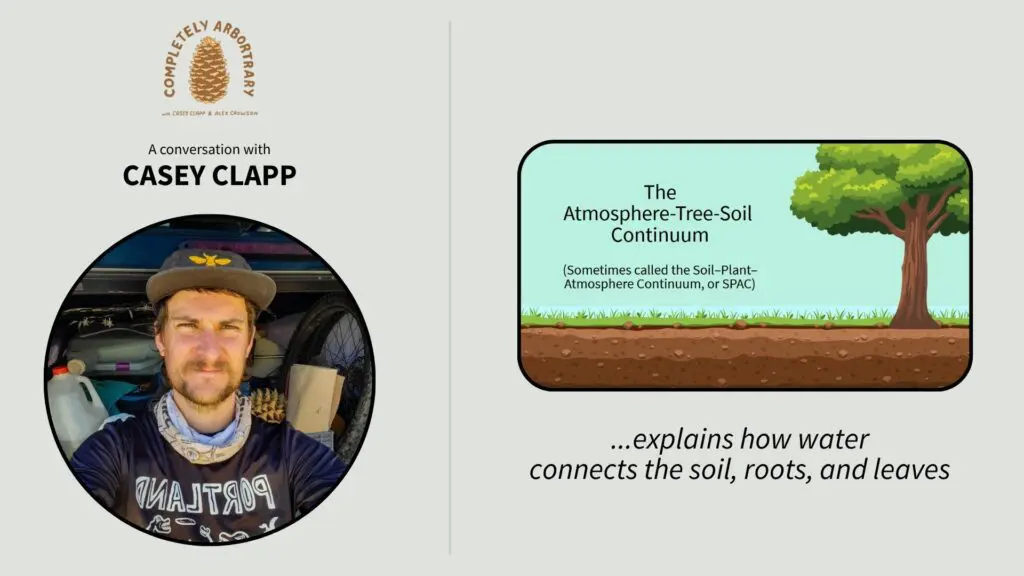
Here’s a simple way to picture it:
- Water moves through the soil
- Roots absorb that water
- The tree pulls it upward
- And eventually, it exits through the leaves
As water moves through the tree, it carries dissolved minerals from the soil along with it. These minerals are nutrients like nitrogen, potassium, and calcium that the tree needs to grow. That’s why watering and feeding fruit trees go hand in hand. If your soil is dry, the nutrients are still there, but your tree can’t access them. It won’t just be thirsty. It can be starving too.
So in this article, we’ll explore how watering and feeding fruit trees works together, and why that connection matters for your tree’s health. Then I’ll share simple, practical ways to fertilize your fruit tree so it stays healthy, thriving, and productive.
By the way, this is a quick summary of an Orchard People podcast. We’ve pulled out the highlights to give you a taste of the conversation—but there’s so much more in the full episode. Scroll down to watch or listen and hear the full story in context.
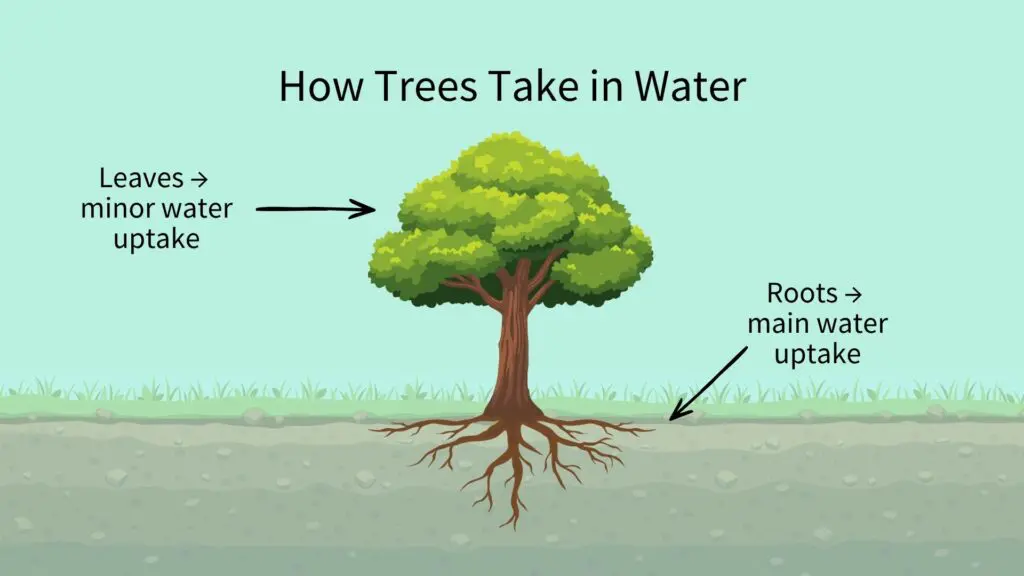
Trees take in water in two ways—but one matters most
Trees take in water in two ways, but one matters most.
- Roots do most of the work, with about 90% of a tree’s water uptake happening below ground.
- Leaves can absorb small amounts of moisture, like in fog or from foliar sprays, but that’s not the main system.
So when you’re thinking about watering and feeding fruit trees, remember this: most of the action is in the soil.
How water moves through a fruit tree
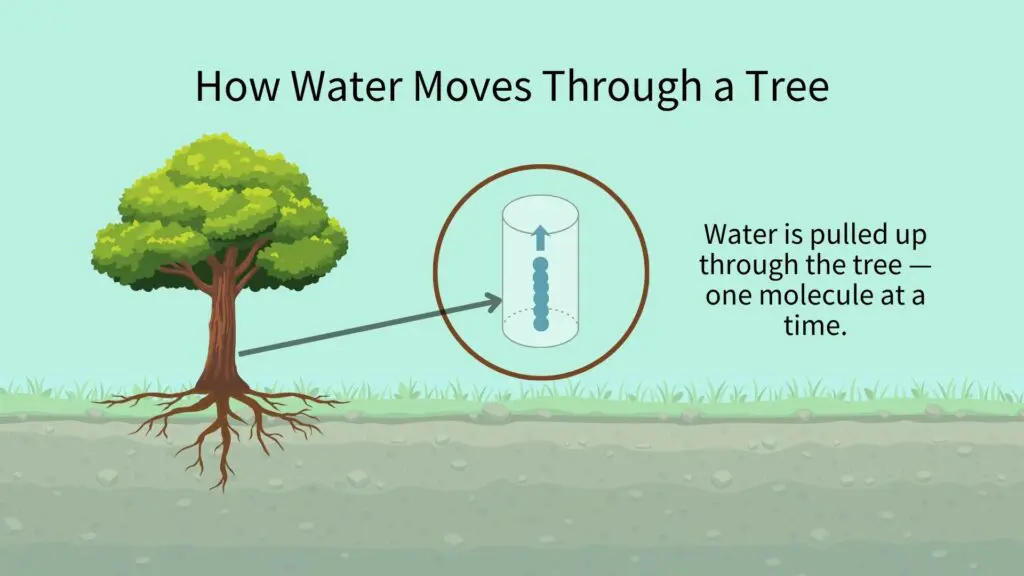
Inside the tree, water travels upward through tiny tubes called xylem. You can picture this as a chain of water molecules being pulled upward one molecule at a time like water moving through a straw. This pull comes from evaporation at the leaves, a process called transpiration.
At the same time, another pathway is working in the opposite direction. The phloem moves sugars, or food, back down to the roots. So while water and minerals move up through the xylem, sugars move down through the phloem.
Photosynthesis is where water becomes food
This is where watering and feeding fruit trees come together inside the leaves.
Leaves take in carbon dioxide (CO₂) from the air, while roots bring up water and minerals from the soil. Using sunlight, the tree turns these into sugars through photosynthesis.
These sugars are the tree’s main food. They fuel growth, feed the roots, support fruit production, and even feed soil organisms. The minerals from the soil play a different role. They support these processes, helping the tree stay strong and function properly, but they don’t provide energy the way sugars do.
So water isn’t just transporting nutrients. It’s helping the tree make its food. That’s why watering and feeding fruit trees are so closely connected.

Trees rely on fungal partners to find more water and nutrients
One thing that really stood out in my conversation with Casey Clapp is how important fungi are when it comes to watering and feeding fruit trees.
Underground, tree roots form partnerships with beneficial fungi in what’s called a mycorrhizal relationship. These fungi grow incredibly fine threads through the soil. They’re much thinner than roots, so they can slip into tiny spaces that roots can’t reach. They also spread farther, helping the tree access more water and nutrients.
In return, the tree releases excess sugars from photosynthesis into the soil. The fungi—and other beneficial organisms—feed on those sugars. So the fungi help feed the tree, and the tree helps feed the fungi and its other underground partners. It’s a true symbiotic relationship.

Where you water a fruit tree matters just as much as how much
Now we know roots take up water and nutrients from the soil. But not all roots do the same job. The larger, woody roots, usually found closer to the trunk, help anchor the tree and move water. They don’t do much absorbing. That job belongs to the fine feeder roots, or root hairs, which usually form on newer root growth near the outer edge of the canopy.
So where you water depends on the age of your tree. In a young tree, the root system is still small, so the absorbing roots may be closer to the trunk. But as the tree grows, the roots spread outward. The most active zone shifts toward the newer roots at the edges, where fine root hairs take in water and nutrients. That’s why, on a mature tree, the best place to water is often near the drip line, the outer edge of the canopy.
So instead of watering only at the base of your tree, keep its age and size in mind. Move your watering outward as the root zone expands.
How to water fruit trees effectively
So now that we understand how water moves through a tree, the next question is: how do you actually water it?
In my conversation with Casey, one thing really stood out. Keep it simple. You don’t need complicated systems to water your fruit trees well. You just need to water deeply, pay attention to the soil, and adjust as your tree grows.
Here are two easy approaches he recommends:
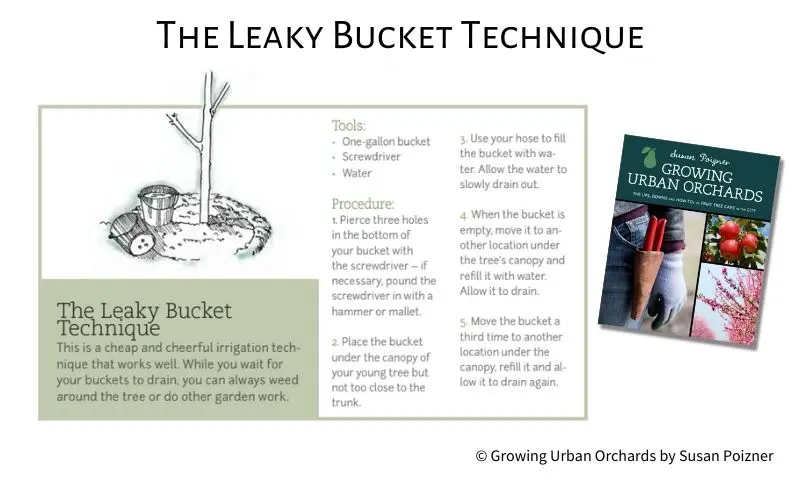
- Deep watering for young trees: Water deeply once a week, using about 10 to 15 gallons. In hot weather, you may need to water twice a week. Aim for soil that stays moist but not soggy. A simple way to do this is the “leaky bucket” method. Drill a few small holes in the bottom of a bucket, place it near the root zone, and let the water slowly soak into the soil.
- Less frequent, deeper watering for established trees: Mature trees often need far less watering than people expect, especially if they’re getting regular rainfall. But during dry spells, they benefit from a deep soak every few weeks rather than frequent, shallow watering.
Before you water, it’s always worth checking the soil. Dig down a couple of inches with your fingers. If it feels dry, water. If it still feels moist, wait until it dries out a bit. Fruit trees don’t like “wet feet,” and roots can suffer from rot if the soil stays soggy.
And how you water matters too. Sprinklers may seem easy, but they tend to waste water, wet the leaves, and miss the root zone. Wet foliage can also encourage the spread of common fruit tree diseases. A better approach is to water slowly at the soil level so it can soak in deeply and reach the roots.
If you want to go deeper into this, I’ve got a full podcast episode called How to Water a Fruit Tree (and How NOT to Water), where I talk with root expert Robert Kourik about what studies show and why drip irrigation can be so effective
Feeding fruit trees: build your soil first, use fertilizer carefully
Now that we’ve seen how closely watering and feeding fruit trees are connected, the next question is how to actually feed your tree in a way that supports that system.
A gentle and effective approach is to focus on building your soil first.
So, instead of relying heavily on synthetic fertilizers, mulch your tree with compost each spring. A layer of compost mulch feeds the tree slowly, supports soil life, and improves soil structure over time. It also helps the soil hold moisture, which makes both watering and nutrient uptake more effective.
Fertilizers are different. They’re concentrated, and if they’re not used carefully, they can do more harm than good. They can even burn roots or push weak, unbalanced growth.
As Casey points out, it’s best to start with a soil test before adding any fruit tree fertilizer that you find in the garden center:
“You should always get a soil test… otherwise you’re just throwing things at the problem.”
So compost builds the system. Fertilizer, if you use it at all, should be targeted and used with care.
The big takeaway: it’s all one system
When you step back, watering and feeding fruit trees aren’t separate tasks at all. They’re part of one continuous system. Water dissolves nutrients. Soil life helps make them available. Roots take them up, and the tree moves them around and turns them into the sugars it needs to grow and produce fruit.
So the next time something feels off with your tree, pause before reaching for fertilizer. Take a moment to look at the whole picture. Is the soil holding moisture properly? Is water reaching the right roots? Is the system working as it should?
When that system is in balance, everything else gets easier.
If you’d like to go deeper, I’ve put together a collection of guides on how to water and feed fruit trees, including soil care, composting, and when (and if) to use fertilizers.
And if you’d like to hear this conversation in full, and enjoy Casey’s storytelling and insights, be sure to listen to the podcast.
Watering Your Fruit Tree: What Every Grower Should Know #orchardpeople #fruittreecare

Grow
Fruit Trees
That Thrive
Fruit Trees
That Thrive
Sign up for our newsletter and get this free eBook

Sign up for our newsletter and get this free eBook

Susan Poizner
Award-winning author, podcaster, fruit tree care educator and creator of the fruit tree care education website OrchardPeople.com. Learn more about Susan on the about us page.
YOU MAY ALSO BE INTERESTED IN

Red-Fleshed Apples: What They Taste Like, How to Grow Them, and Why They’re So Interesting

When to prune fruit trees
Wondering when to prune fruit trees? In this blog, we explore which trees benefit most from winter pruning and when Read more

When to Plant Bare Root Fruit Trees?
When to plant bare root trees? The best time to plant bare root trees is in the spring or fall Read more

Bush Cherry vs Dwarf Cherry Tree: Best Picks for Your Small Garden
Dwarf cherry tree, or cherry shrub: which is a better choice for your small garden?