
Why do some fruit trees thrive while others struggle? We compare two community orchards and explore what soil biology can Read more
How to Read a Soil Test for Fruit Trees: What Your Results Really Tell You
You’ve done the first brave thing already: you took a close look at your soil.
Maybe you squeezed a handful to see how it crumbles. Maybe you watched how quickly water drains after a rain. Or maybe you went one step further and sent a soil sample to a lab.
When the results come back, many gardeners feel a mix of curiosity and confusion. There are numbers everywhere—pH, nitrogen, organic matter, electrical conductivity.
It can feel a little like reading a medical report for your garden.
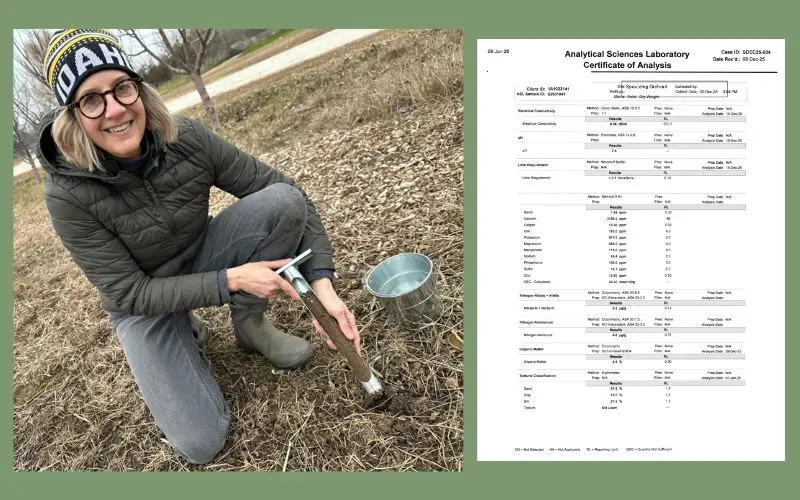
So the real question becomes: what do you actually do with those numbers?
When you send in a soil test, the lab will usually ask what you're growing. If you tell them you're growing fruit trees, they'll often include ideal ranges right in the report. That way, you can easily see what's in a good range, and what might need attention.

By the way, this is a quick summary of an Orchard People podcast. We’ve pulled out the highlights to give you a taste of the conversation—but there’s so much more in the full episode. Scroll down to watch or listen and hear the full story in context.
Start preparing soil for fruit trees by observing the soil you already have
A soil test is incredibly helpful—but it doesn’t replace your own observations.
Before Ariel even received the lab results, she had already learned a lot about the soil simply by examining it in the field.
“We were using our eyes, our hands, our noses.”
Simple observations can reveal important clues:
- Soil structure: Does the soil crumble easily or form dense clods?
- Drainage: Does water soak in quickly or sit on the surface?
- Organic matter clues: Darker soil often contains more decomposed plant material.
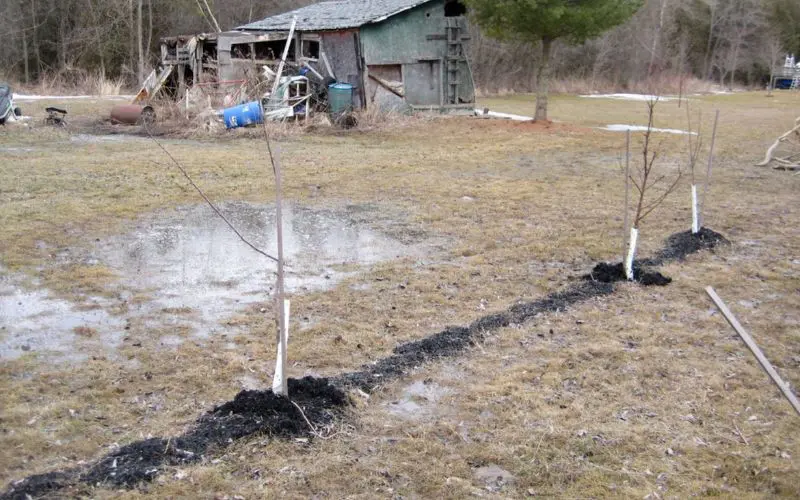
These observations help you interpret soil test results in context.
For example, a soil report might say your soil contains clay. But your own observation will tell you whether that clay drains well—or whether it becomes compacted and difficult for roots to grow through.
Preparing soil for fruit trees works best when field observations and lab results work together.
Soil pH is one of the first things to look for when learning how to read a soil test
When Ariel receives a soil test report, the first number she looks at is soil pH.
Soil pH measures how acidic or alkaline your soil is. This matters because pH affects how easily plants can absorb nutrients.
Even if nutrients are present in the soil, fruit trees may struggle to access them if the pH is outside the ideal range.
For many fruit trees, a healthy range is around pH 6.8 to 7.3, which is close to neutral.
In Ariel’s soil sample, the pH measured 7.4. That’s slightly alkaline but still workable for many fruit trees.
But there’s an important nuance.
Different plants tolerate pH differently. Apples, pears, and many stone fruits can often adapt to slightly alkaline soil. Blueberries, however, strongly prefer acidic soil.
This is why preparing soil for fruit trees involves understanding both the soil and the crop you want to grow.

Electrical conductivity helps reveal salt buildup in soil
Another number that appears on many soil tests is electrical conductivity (EC).
While it sounds technical, it simply measures how easily electricity moves through the soil solution. In practical terms, it helps estimate salt levels in the soil.
High salt levels can damage fruit trees because salts interfere with the plant’s ability to absorb water.
Salt buildup can occur when:
- Fertilizers are applied heavily
- Manure is added repeatedly
- Irrigation water contains dissolved salts
- Road salt accumulates near planting areas
Ariel pointed out something many gardeners don’t realize: manure is natural, but it can still contribute significant salt levels if applied excessively.
So when preparing soil for fruit trees, it’s important to think about soil improvements in moderation and over time.
Soil texture determines drainage, aeration, and nutrient retention
A soil test can also confirm the texture of your soil.
Soil texture describes the proportion of sand, silt, and clay particles.
In Ariel’s example, the soil was classified as silt loam, consisting of roughly:
- 27% sand
- 57% silt
- 15% clay
This combination is often excellent for fruit trees.
Each component behaves differently:
Sand
Large particles that create air spaces in soil. These spaces allow water to drain easily and help roots breathe.
Silt
Medium-sized particles that help the soil retain moisture and nutrients.
Clay
Very fine particles that hold nutrients well but can create dense soil if present in large amounts.
A silt loam soil offers a nice balance—holding nutrients while still allowing good drainage.
However, even good soil can become compacted if it is worked when wet. Compacted soil reduces pore space and can restrict root growth.
Understanding soil texture is therefore an important step when preparing soil for fruit trees.
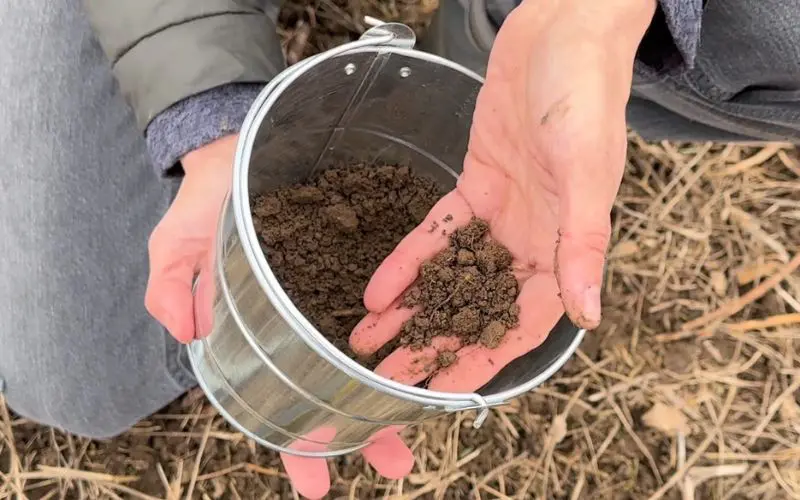
Organic matter quietly supports long-term soil health
One number on a soil test that deserves careful attention is organic matter.
Organic matter consists of decomposed plant material, roots, microbes, and other biological residues.
It plays a powerful role in soil health because it:
- Improves soil structure
- Helps soil hold moisture
- Supports beneficial microbes
- Slowly releases nutrients
The orchard soil Ariel tested contained about 2.4% organic matter, with a target range of anything between 1 to 5%.
That may sound low, but in an arid climate soil it’s actually quite reasonable.
The key takeaway is that soil health targets depend on regional climate and soil type.

One gentle way to build organic matter while preparing soil for fruit trees is by planting cover crops—plants grown specifically to improve soil health. The purpose and combination of potential benefits are what Ariel refers to as "complex matchmaking."
Their roots feed soil microbes, and when the plants decompose they add organic matter to the soil.

Nitrogen is essential for fruit tree growth but hard to measure
Of all the nutrients on a soil test, nitrogen is often the one growers pay the most attention to.
Nitrogen supports leafy growth and helps trees produce energy through photosynthesis, but it’s also one of the hardest nutrients to measure accurately. That's because nitrogen moves quickly through soil systems.
For example, it can:
- Leach downward with rain or irrigation
- Escape into the air
- Be temporarily used by soil microbes
Because of this, soil tests often show recent nitrogen conditions rather than long-term supply.
In Ariel’s example, nitrogen levels appeared low. But the soil had been tested late in the season—after the trees had already used much of the available nitrogen.
That’s why soil test results always need to be interpreted alongside timing, climate, and tree growth stage.
Healthy soil develops gradually over time
One of the most reassuring messages from this conversation is that soil health develops slowly.
Preparing soil for fruit trees isn’t about fixing everything in one season. It’s about steadily improving the soil ecosystem.
That might include:
- Mulching with compost
- Growing cover crops
- Protecting soil structure
- Avoiding unnecessary soil disturbance
- Supporting beneficial soil life
Over time, those practices help the soil become more resilient and supportive of fruit tree growth.

As Ariel explained, soil is a living system—and when we support that system, our trees benefit too.
Listen to the full conversation
If you’d like to hear Ariel walk through these soil test results in more detail, listen to the Orchard People podcast episode for the full conversation.
How to Read a Soil Test for Fruit Trees (and What to Try Next) with Ariel Agenbroad (Eps 125)

Grow
Fruit Trees
That Thrive
Fruit Trees
That Thrive
Sign up for our newsletter and get this free eBook
Sign up for our newsletter and get this free eBook

Susan Poizner
Award-winning author, podcaster, fruit tree care educator and creator of the fruit tree care education website OrchardPeople.com. Learn more about Susan on the about us page.
YOU MAY ALSO BE INTERESTED IN

Why do some fruit trees thrive while others struggle?

When to prune fruit trees
Wondering when to prune fruit trees? In this blog, we explore which trees benefit most from winter pruning and when Read more

When to Plant Bare Root Fruit Trees?
When to plant bare root trees? The best time to plant bare root trees is in the spring or fall Read more

Bush Cherry vs Dwarf Cherry Tree: Best Picks for Your Small Garden
Dwarf cherry tree, or cherry shrub: which is a better choice for your small garden?