Why do some fruit trees thrive while others struggle? We compare two community orchards and explore what soil biology can Read more
Vertical Mulching for Fruit Trees: When Surface Mulch Isn't Enough
What’s the best way to feed a fruit tree?
If you’re a home grower or small-scale orchardist, the answer may surprise you. It isn’t always fertilizer from the garden center. Often, the best way to feed fruit trees naturally is to feed the soil with compost, wood chips, or another type of natural mulch.
Surface mulch is wonderful. It helps hold moisture in the soil, supports beneficial organisms, and gradually improves soil health.
But what if your soil is so hard and compressed that roots, water, and air can barely move through it?
That’s where vertical mulching for fruit trees may help.
This article is based on a conversation with Dr. Glynn Percival, Senior Arboricultural Research Manager at Bartlett Tree Experts in the UK, about compacted soil, worms, root health, and how vertical mulching can help stressed trees move from surviving to thriving.
By the way, this is a quick summary of an Orchard People podcast. We’ve pulled out the highlights to give you a taste of the conversation—but there’s so much more in the full episode. Scroll down to watch or listen and hear the full story in context.
If you don’t like digging it, trees don’t like growing in it
Dr. Percival offered a wonderfully simple way to recognize compacted soil:
“If you don’t like digging it, trees don’t like growing in it.”
In other words, if you push a spade or garden fork into the ground and it feels like concrete, your tree roots may be struggling too.
Compacted soil creates two major problems. First, roots have trouble physically pushing through dense soil. Second, compacted soil has fewer air spaces. That matters because roots are alive, and living roots need oxygen.
This is easy to overlook. When a fruit tree looks weak, many of us look first at fertilizer, watering, pests, or pruning. Those can all matter, but the problem may begin below ground.
Compacted soil can make fruit trees look stressed above ground
A tree growing in compacted soil may have a sparse canopy, pale leaves, premature leaf drop, or brown edges on the leaves. It may also produce very little new growth.
Dr. Percival likes to measure annual shoot growth at the end of the growing season. For many healthy landscape trees, he looks for at least 4 inches (~10 centimeters) of new growth per year. Fruit trees often grow more than that, depending on the species, age, and rootstock. So if a fruit tree is barely growing, that is worth investigating.
Slow growth does not automatically mean compacted soil. Poor drainage, drought, nutrient imbalance, planting depth, disease, root damage, or other stressors may also be involved. But compaction is worth checking because it can make every other problem harder for the tree to recover from.
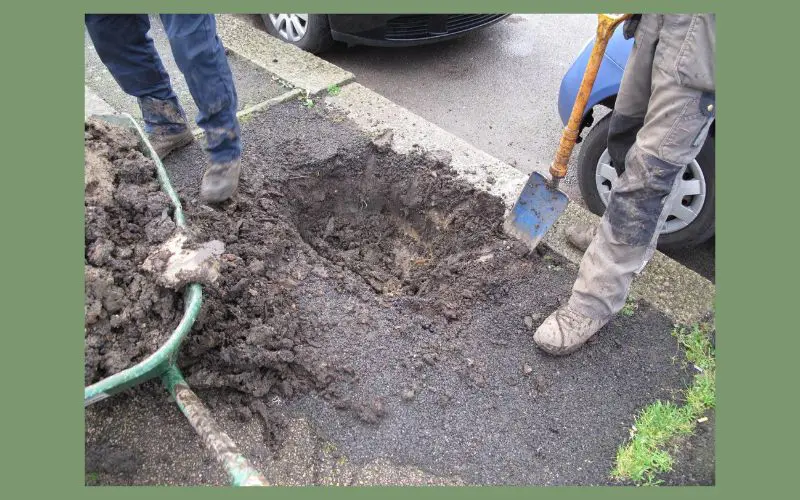
A simple first step is to dig a small test hole or push a garden fork into the soil beneath the tree canopy. Notice how easily the tool enters the ground. Look for earthworms. Observe whether the soil crumbles or breaks into dense chunks. These small observations can tell you a lot.
Vertical mulching is different from surface mulching
Most fruit tree growers are familiar with surface mulching. You remove grass around the tree, spread compost or wood chips, and keep the mulch away from the trunk. That kind of mulching feeds soil life from above.
Vertical mulching works differently.
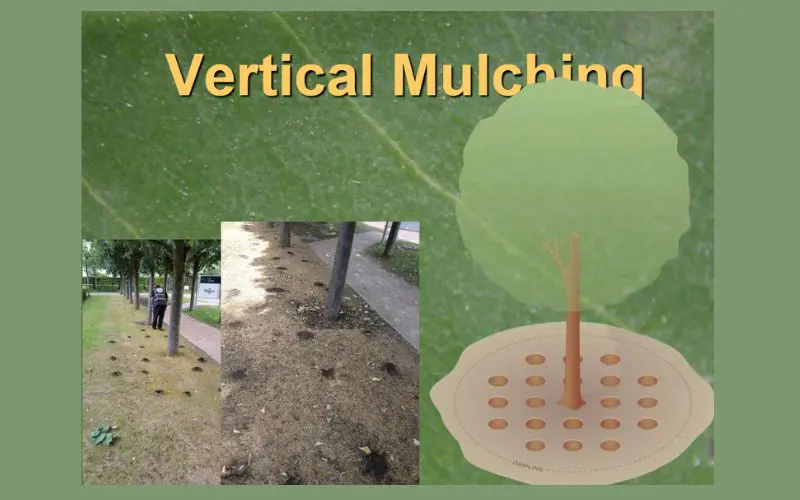
Instead of placing organic matter only on top of the soil, vertical mulching involves making narrow holes in compacted soil and filling those holes with improved materials. Dr. Percival describes it as taking cores of poor soil out of the ground and backfilling those holes with a better mix.
That mix might include good quality topsoil, compost, organic matter, and sometimes biochar. Biochar is a charcoal-like soil amendment that can help improve soil structure and nutrient-holding capacity when used appropriately.
The goal is not simply to “feed” the tree through the holes. The goal is to create channels where roots, water, air, and soil organisms can begin moving again.
Start with soil testing and observation before adding amendments
One point Dr. Percival emphasized is that vertical mulching should begin with understanding the soil. In his work, he would first assess whether the soil was compacted, test its nutrient composition, and look at drainage.
For home fruit growers, the practical lesson is simple: don’t guess if you can observe and test.
Before deciding on vertical mulching, ask:
- Is the soil difficult to dig?
- Does water drain poorly or pool after rain?
- Is the tree growing poorly despite reasonable care?
- Has the site been compacted by construction, vehicles or foot traffic?
- Have you done a soil test to better understand pH and nutrient levels?
Vertical mulching is most relevant when compaction is part of the problem.
You can use a mechanical auger or a Dutch auger
For the actual work, Dr. Percival described two tools. A mechanical auger is like a large drill that makes holes in the soil. It is faster, but more expensive. A Dutch auger is more like a giant corkscrew. It takes more time and effort, but it is less expensive and can last for years.
In his work, Dr. Percival often used holes about 3 inches wide and 12 to 15 inches deep (roughly 7.6 centimeters wide and 30 to 38 centimeters deep). That depth reaches a useful portion of the root zone, since many tree roots grow in the upper layers of soil. But he also notes that there are no hard and fast rules. Even shallower holes can be beneficial in some situations.
The holes are usually made in a pattern beneath the tree canopy, not right against the trunk. The goal is to reach the area where many feeder roots are active.
What about root damage?
One common concern with vertical mulching is root damage. After all, if you drill holes around an established tree, you may cut through some roots.
Dr. Percival acknowledges that criticism, but his view is that the short-term damage can be outweighed by the long-term benefit when soil compaction is severe. If the tree is already declining because roots cannot grow through dense soil, leaving the soil unchanged may be more harmful than carefully creating improved channels.
That does not mean vertical mulching should be done casually. It is not something every healthy tree needs. But for trees growing in heavily compacted soil, it may offer a practical way to improve conditions around the roots.
Worms can help the soil recover naturally
One of the most fascinating parts of Dr. Percival’s research involved worms.
“Soil is a living, breathing organism,” he explained. Earthworms help loosen compacted soil, improve structure, create tunnels, and move organic matter through the soil. As they feed and move, they help create natural pathways for air and water.
In a trial in Stockley Park, a business estate in the UK where the soil had been heavily compacted, Dr. Percival and his team added worms to some of the treated areas. The idea was to create improved pockets of soil, then allow the worms to spread outward over time. The holes were placed close together because worms cannot be expected to travel far through terrible soil before resources run out.
For that reason, spacing matters. In the trial, Dr. Percival emphasized holes spaced about 30 to 50 centimeters apart, or roughly 1 to 1.5 feet. That gave worms and soil life a better chance to move gradually from one improved area to the next.

The Stockley Park trial showed visible improvements
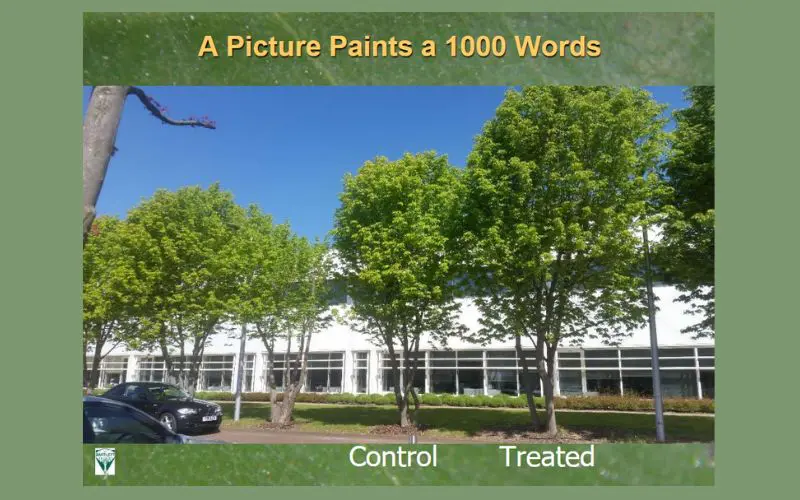
Stockley Park, near Heathrow Airport, had thousands of trees growing in a highly managed landscape with serious compaction issues. Dr. Percival described many of the trees as “surviving, not thriving.”
Because the site was so large, fully decompacting the entire landscape was not practical. Instead, the team created treated pockets or “islands” of improved soil and tested different combinations of amendments, including biochar, fertilizers, clover cover crops, wood chip mulch, and worms.

They measured the results in several ways. They looked at soil respiration, which indicates biological activity. They watched for worm casts. They measured leaf color, canopy growth, and other signs of tree health.
The results were encouraging. Dr. Percival noted that treated trees showed noticeable improvements, including canopy increases of 30 to 40 percent in some cases. The visual difference between treated and untreated trees was striking.
Of course, this was a research setting, not a backyard orchard. But the lesson still matters for fruit growers: when soil compaction is limiting root growth, improving the soil environment can change what happens above ground.
Is vertical mulching right for your fruit tree?
Vertical mulching for fruit trees may be worth considering if the soil is severely compacted, the tree is growing poorly, and surface mulch alone does not seem to be enough. It may be especially relevant on sites that have been affected by construction, heavy equipment, vehicle traffic, or years of compacting activity around the root zone.
It may not be necessary for a healthy tree growing in loose, well-drained, biologically active soil. In that case, surface mulching, thoughtful watering, cover crops, and regular soil testing may be enough.
The key is to match the practice to the problem.
As Dr. Percival put it, “Honestly, there’s no real rocket science here.” You are creating holes, removing poor compacted soil, replacing it with better soil and organic matter, and, in some cases, encouraging worms and soil biology to do the long-term work.
Grow
Fruit Trees
That Thrive
Fruit Trees
That Thrive
Sign up for our newsletter and get this free eBook

Sign up for our newsletter and get this free eBook
Vertical mulching helps you look below the surface
Vertical mulching is not a magic fix, and it is not a substitute for good fruit tree care. But it can be a useful tool when compacted soil is keeping roots from growing, breathing, and accessing the resources they need.
If your fruit tree is struggling, don’t rush immediately to add more fertilizer. Start by observing the soil. Try digging. Look for worms. Notice drainage. Think about the history of the site.
Then, if compaction seems to be part of the problem, vertical mulching may be one practical way to help your tree move from surviving to thriving.
Listen to the podcast for more info, including Dr. Percival’s full explanation of the Stockley Park research and how worms became part of the vertical mulching story.
Vertical Mulching for Fruit Trees Explained (Eps 129)


Susan Poizner
Award-winning author, podcaster, fruit tree care educator and creator of the fruit tree care education website OrchardPeople.com. Learn more about Susan on the about us page.
YOU MAY ALSO BE INTERESTED IN
Why do some fruit trees thrive while others struggle?
Why buy a young whip if there are large fruit trees for sale?
Should you pay more for a larger fruit tree to plant in your garden? Will that lead to a healthier Read more
When to prune fruit trees
Wondering when to prune fruit trees? In this blog, we explore which trees benefit most from winter pruning and when Read more

Holistic Sprays for Fruit Trees
Discover how holistic sprays for fruit trees may help prevent fruit tree pests and diseases by boosting your tree's health.