Why do some fruit trees thrive while others struggle? We compare two community orchards and explore what soil biology can Read more
Evaluate Your Soil Before Planting Fruit Trees
Preparing soil for fruit trees is one of the most important steps you can take. And it’s also one of the most overlooked.
Most of us get excited about choosing the tree. We research cultivars. We think about flavour, chill hours, and disease resistance. But then we walk outside, look at a patch of lawn, and think, “That’ll do.”
But that's not good enough, and that's a lesson I learned on a visit to Boise, Idaho. Idaho is famous for its potatoes, but it’s also a fantastic place to grow fruit trees.
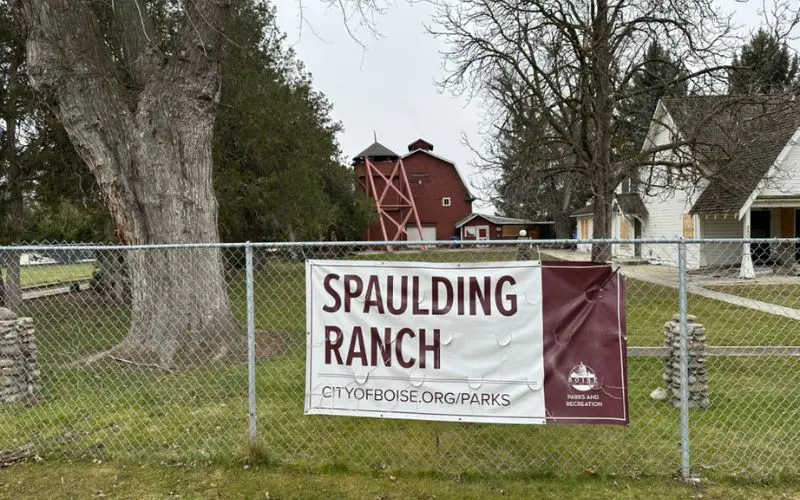
I got to spend time with Ariel Agenbroad from University of Idaho Extension. She’s a plant scientist who has been helping the city evaluate whether they should expand a community orchard at Spaulding Ranch, a historic 20-acre agricultural site right in the middle of Boise.
Apples, pears, nectarines, and peaches are already thriving there. But before anyone rushes out to buy more trees, Ariel’s first step is simple. She evaluates the soil.
Preparing soil for fruit trees doesn’t start with adding compost or digging a big hole. It starts with evaluating the soil you already have. And the good news? You don’t need fancy equipment or lab tests. Just simple observations and hands-on checks you can do right in your backyard.
In this article, I’ll walk you through the exact process Ariel uses before a single new tree goes into the ground.
Let’s dig in.
By the way, this is a quick summary of an Orchard People podcast. We’ve pulled out the highlights to give you a taste of the conversation - but there’s so much more in the full episode. Scroll down to watch or listen and hear the full story in context.
Soil should be your first thought, not an afterthought
When we look at fruit trees, we see branches, blossoms, and beautiful fruit. Soil is seemingly invisible and easy to ignore. But Ariel reminded me of something important:
“For up to three to five years, the trees are not producing fruit. They’re establishing root systems and their framework for future fruit production.”
In other words, those early years are about roots. And everything, including fruit quality, firmness, color, ripening, and storage life, depends on how well those roots can access water and nutrients. If the soil isn’t right, the tree struggles before it ever gets a chance to produce a healthy harvest.
Evaluate your soil with your senses before you ever send it to a lab
So how do you know if your soil is good enough? Ariel’s answer to that question is simple. Look at it. Touch it. Smell it.
Here’s what to notice:
- Does the soil drain well, or does it stay swampy?
- Does it stick to your boots?
- When you dig into your soil, do you notice earthworms?
- Does it smell fresh and earthy (not sour)?
- Are your existing plants healthy and vigorous?
Healthy soil is:
- Workable (not rock hard)
- Well-draining
- Biologically active
- Supporting strong plant growth
Soil color can give you important clues about organic matter and fertility
Interestingly, the color of the soil will tell you something. Some soils are naturally red, yellow, or tan depending on the geology. That’s not something you can change.
But in gardens and orchards, darker soil often signals higher organic matter. As Ariel explained during our interview, if your soil looks like chocolate cake, you’re probably in good shape.
Dark, rich soil often contains:
- More organic matter
- More biological life
- Better nutrient-holding capacity
But not all regions, and not all backyards, naturally have dark soil. In some areas, you’ll need to build organic matter over time.
One of the simplest ways to build soil organic matter over time is through proper mulching. You can read more in our article on mulching fruit trees.
A soil probe helps you assess compaction, texture, and root potential
One of the tools Ariel uses is an inexpensive soil probe (affiliate link). It’s a long metal tube with a window along the side. You push it into the ground and pull up a core of soil so you can see the soil profile and how the colour and texture change as you go deeper.
When Ariel inserted the soil probe into the ground, she wasn’t just checking how deep it would go. She was gathering several important clues at once.
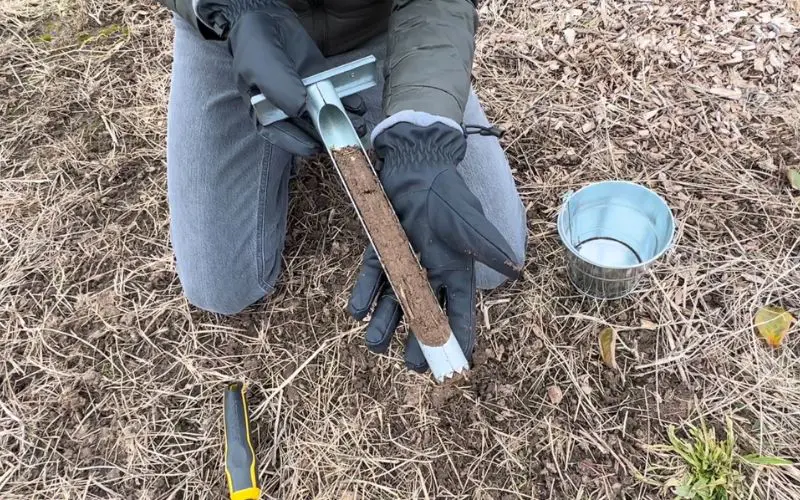
Here’s what a soil probe can tell you:
- How easily the probe enters the soil. If it slides in with moderate pressure, that suggests workable soil with minimal compaction. If it barely penetrates, there may be a dense or compacted layer restricting roots.
- Consistency through the rooting zone (top 10–12 inches). You want relatively consistent soil in the main root zone. Sudden changes in texture can signal disturbance.
- Texture clues from the core sample. Is it gritty (sandy)? Smooth and silky (silty)? Sticky and dense (clay)? Most fruit trees prefer a balanced mix.
- Presence of layers. If you see abrupt changes — for example, loose soil on top and dense material below — roots may struggle to move downward.
And here’s an important consideration: sandy soil may allow a probe to slide in easily, but that doesn’t automatically make it ideal. Sandy soils drain quickly and are easy for roots to penetrate, but they may not hold enough water or nutrients. Good soil isn’t just about penetration. It’s about balance.
At Spaulding Ranch, the probe slid down easily and revealed a consistent silt loam — a soil type that contains a balanced mix of sand, silt, and clay, with slightly more silt. Silt loam feels smooth and slightly silky, holds moisture well, and still drains reasonably well. That balance makes it especially well-suited for fruit trees.
But in a nearby construction area? The probe barely went in.
That’s a red flag.
Soil structure matters just as much as soil texture
Here’s an important distinction.
- Soil texture = proportions of sand, silt, and clay (you can’t change this much).
- Soil structure = how those particles clump together (you can improve this).
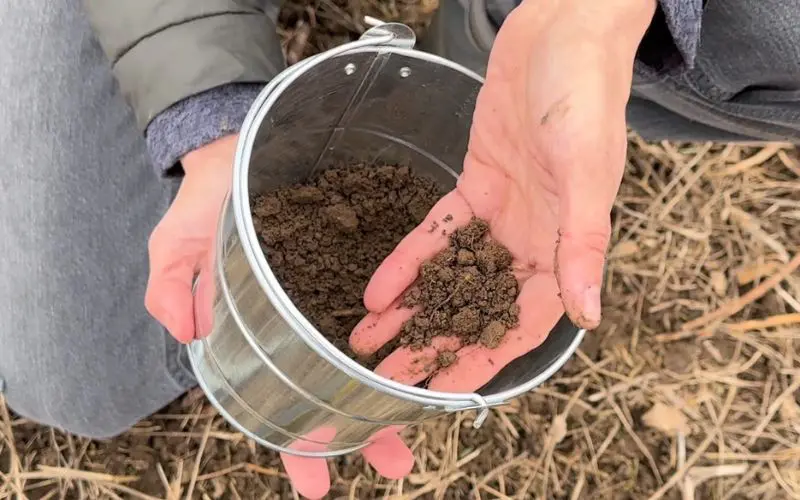
When Ariel scooped up a handful of soil, it crumbled beautifully—not dusty, not hard clods.
Good structure means:
- Roots can move through the soil
- Water can drain properly
- Air can circulate
- Soil microbes can thrive
If your soil is powdery like dust, roots struggle to anchor. If it’s dense and blocky, drainage suffers. You’re looking for that “just right” crumb.
Construction damage can create compacted layers that kill young fruit trees
We then walked two minutes away to a former construction zone. The difference was shocking. The landscape flag barely penetrated five inches. The soil probe struggled to go in an inch. The soil was hard, compacted, lifeless.
Ariel explained that construction often leaves behind:
- Compacted subsoil
- Road mix or debris
- Disturbed soil horizons
- Hardpan layers
Hardpan is a dense, compacted layer of soil, often caused by heavy machinery or repeated pressure, that roots struggle to penetrate. It can restrict drainage and trap water above it.
And here’s the big problem:
“We see more young fruit trees die because of flooded root zone conditions and the inability to ever dry out.”
Most people think young fruit trees die from lack of nutrients. More often, they die from poor drainage. If water has nowhere to go, roots suffocate. That’s why planting into heavily compacted post-construction soil without preparation is risky.

Organic matter and site history explain why soil varies across a property
At Spaulding Ranch, Ariel tested five different areas across the site. Four had similar soil texture (silt loam) but the area disturbed by construction tested differently. What varied most wasn’t texture. It was organic matter, nutrient levels, and compaction.
Areas that had been cropped, amended, and cared for had higher organic matter and better soil health. Areas that had experienced construction, weed-only management, or disturbance showed lower organic matter and reduced nutrient content.
This matters because soil history shapes root success. Even within one property, digging test holes in multiple spots can reveal very different conditions.
Preparing soil for fruit trees isn’t about perfection. It’s about understanding what you’re working with and improving structure where needed.
You can perform simple at-home texture tests to understand your soil
Without a lab, you can try:
The ball test
Squeeze moist soil in your hand.
Does it hold together?
The ribbon test
Press soil between your fingers and try to form a ribbon.
- Long ribbon = more clay
- Short ribbon = more silt/loam
- No ribbon = sandy soil
At Spaulding Ranch, the soil formed a short ribbon—classic silt loam.
Silt loam is wonderful for fruit trees:
- Holds water well
- Holds nutrients
- Still drains reasonably well
Preparing soil for fruit trees means addressing compaction and drainage first
If you suspect compaction or poor structure:
- Dig multiple test holes.
- Check drainage (does water pool after irrigation?).
- Look for hardpan layers.
- Add organic matter over time.
- Avoid planting directly into severely compacted soil without remediation.
If you’re wondering how to build soil health safely and naturally, you can read more in our article on how to improve soil quality naturally.
In the next part of this conversation, we dive into exactly how to prepare soil before planting.
But first, take the time to understand what you’re working with.
Listen to the podcast for more in-depth soil preparation strategies
This article gives you the highlights, but there’s so much more in the full conversation with Ariel.
If you’re planning to plant fruit trees this year, I highly recommend you listen to the podcast for more information.
How to Evaluate and Sample Soil Before Planting Fruit Trees with Ariel Agenbroad (Eps 125)

The bottom line is that soil preparation determines your tree’s long-term success
Fruit trees can live for decades. But only if their roots can breathe, drain, and explore. Preparing soil for fruit trees is the foundation for everything that follows.
Before you plant:
- Dig.
- Observe.
- Feel.
- Test.
- Understand your site’s history.
Soil may be hidden—but it’s the foundation of everything. And when you get it right, you’re not just growing fruit. You’re building something that can feed you—and maybe even your community—for years to come.
Grow
Fruit Trees
That Thrive
Fruit Trees
That Thrive
Sign up for our newsletter and get this free eBook
Sign up for our newsletter and get this free eBook

Susan Poizner
Award-winning author, podcaster, fruit tree care educator and creator of the fruit tree care education website OrchardPeople.com. Learn more about Susan on the about us page.
YOU MAY ALSO BE INTERESTED IN
Why do some fruit trees thrive while others struggle?
When to prune fruit trees
Wondering when to prune fruit trees? In this blog, we explore which trees benefit most from winter pruning and when Read more
When to Plant Bare Root Fruit Trees?
When to plant bare root trees? The best time to plant bare root trees is in the spring or fall Read more
How to Prune Old Apple Trees to Produce Better Fruit
Learn how to prune old apple trees.Pruning these old fruit trees will result in better quality fruit and habitat for Read more