Explore how to design a fruit tree garden based on fact, not fantasy. What works, what grows, and what makes Read more
Why buy a young whip if there are large fruit trees for sale?
If you’re in the market for a new apple tree, you may be tempted to go to a nursery where they have large fruit trees for sale. Your reasoning? Certainly larger, more mature fruit trees will look prettier than younger, smaller fruit trees. And then there’s the perception that with a more mature tree you will enjoy an earlier harvest.

large fruit trees are slower to adapt to their new planting location
It is true that if you find a large fruit tree for sale that is more mature, it will produce fruit sooner because it is already at a fruit-bearing stage of its life cycle. In contrast, you may have to wait three to five years for a young, year-old “whip” to produce fruit at all. And yet, I’d say that in the long term, the small fruit tree whip will adapt better to your site. It will be more resistant to pest and disease problems - and it will be more likely to thrive.
Tiny Espalier Apple Trees

Larger, more mature fruit trees are harder to prune and train effectively
In a recent, day-long fruit tree pruning workshop at Mohawk college, offered by Mohawk College’s Sustainability Office in partnership with Environment Hamilton, the group saw another reason why it's better to plant younger fruit trees - It is easier to prune and shape young trees in order to create a solid, fruit-bearing structure that will last for the tree's lifetime.
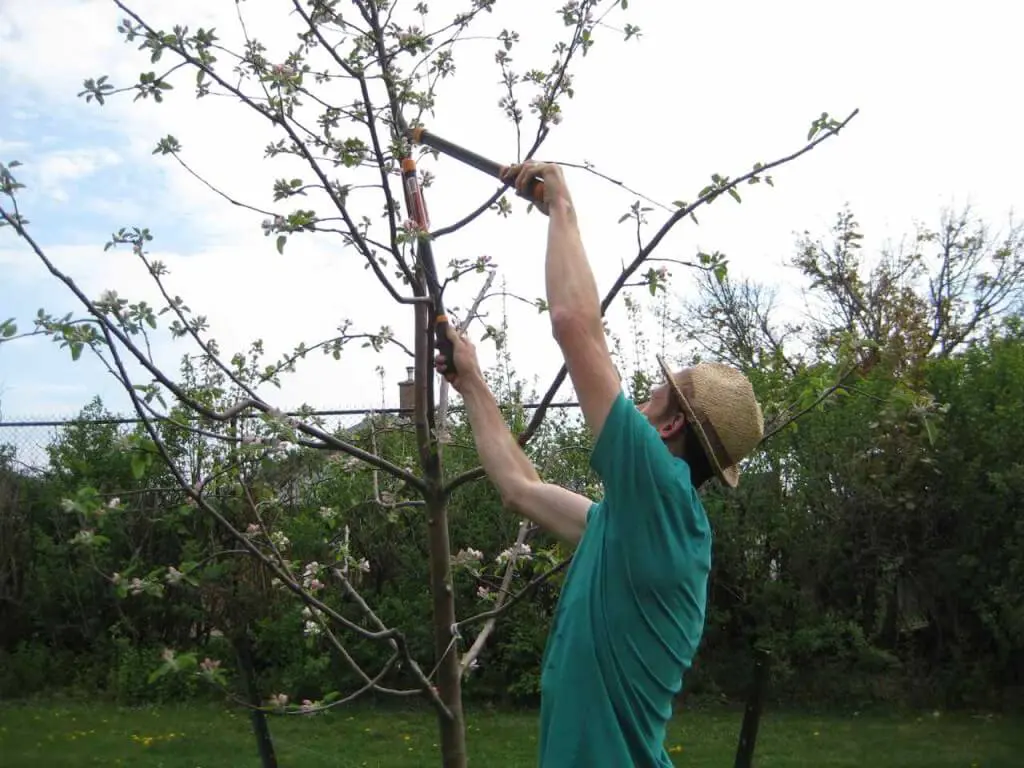
Mohawk has a beautiful orchard with 23 recently planted apple and pear trees. Many of the trees are small. They were just a year or two old when they were planted in 2014. Others were very large trees that may have been five or six years old at planting.
So, after our morning session indoors in which the students learned the principles of correct fruit tree pruning, we took our tools, went out into the orchard, and started to prune the trees.
Our goals were:
- To create a solid fruit-bearing structure for the trees
- To improve tree health
- To spur vigorous tree growth
The younger trees in Mohawk’s Fennel Orchard were easier to prune. Their branches were softer and with correct annual pruning, it will be easy to give these trees a healthy, open structure ideal for optimal tree health and a generous harvest. It will also be much easier to keep the trees a manageable size. When you find a large fruit tree for sale that is more mature, just remember that they are harder to prune, maintain, and harvest.

The older trees, although beautiful, posed more of a challenge. The branches of course were thicker, and the branch structure was already set. The trees were taller than we might want for ease of care and harvest. And since you can only prune about 20 percent of an older tree each year, we were able to clean up those older trees a bit, but we had to leave a lot more of the pruning work for years to come.
Each of the participants had the opportunity to prune at least two trees using their newly acquired skills, and they did a great job. They will also be comfortable pruning these and other fruit trees next year, both in Fennel Orchard and in other orchards to be planted in Hamilton, through groups like Hamilton Victory Gardens.
Will you choose a large fruit tree for sale? or buy a young whip? instead?
As for yourself, will you choose to buy a more mature fruit tree for planting? Or might you consider planting a young whip from a specialist fruit tree nursery? It’s up to you. But if you want to learn more about how to select a fruit tree that will thrive in your unique conditions, check out my book Fruit Tree Garden Design.
Grow
Fruit Trees
That Thrive
Fruit Trees
That Thrive
Sign up for our newsletter and get this free eBook
Sign up for our newsletter and get this free eBook

Susan Poizner
Award-winning author, podcaster, fruit tree care educator and creator of the fruit tree care education website OrchardPeople.com. Learn more about Susan on the about us page.
YOU MAY ALSO BE INTERESTED IN

Fruit Tree Garden Design: Cultivating Your Backyard Orchard
When to prune fruit trees
Wondering when to prune fruit trees? In this blog, we explore which trees benefit most from winter pruning and when Read more

A Superfood in your Garden: How to Grow Seabuckthorn Plants
Learn how to grow nutrient-rich Seabuckthorn berries with plant breeder Bill Schroeder of Agriculture and Agri-Food Canada.

Bush Cherry vs Dwarf Cherry Tree: Best Picks for Your Small Garden
Dwarf cherry tree, or cherry shrub: which is a better choice for your small garden?