Not sure which fruit trees will thrive where you live? Climate plays a much bigger role than most people expect. Read more
Red-Fleshed Apples: What They Taste Like, How to Grow Them, and Why They’re So Interesting
I love apples. One of my favourite things to do is seek out unusual varieties and taste them whenever I get the chance. So when I come across apples with red flesh, I get excited. Sometimes the colour is a soft pink. Other times it’s a deep crimson that almost doesn’t look real. Most of the ones I’ve tried are quite tart, although I know breeders are working on developing red-fleshed apples that are sweet enough to enjoy fresh and could one day even show up in supermarkets.
But recently, I started hearing something new about these apples. People weren’t just talking about their colour or novelty. They were talking about them almost like a superfood, suggesting they might have unique health benefits. That really caught my attention, because it’s not something I had ever heard before in all my years working with fruit trees.
So I decided to dig a little deeper. I reached out to Derek Mills, who grows an incredible range of apple varieties at Hocking Hills Orchard in Ohio, including a large collection of red-fleshed apples. Through that conversation, I was introduced to Jonathan Griffith, a research scientist and founder of Palmetto Nutraceuticals, who has been studying the compounds in these apples and what they might mean for human health.
What unfolded was a fascinating story that connects orchard growing, apple diversity, and emerging research. In this article, we’ll explore Derek’s red-fleshed apple collection, some varieties you might consider growing at home, and what makes these apples so interesting from a health perspective.
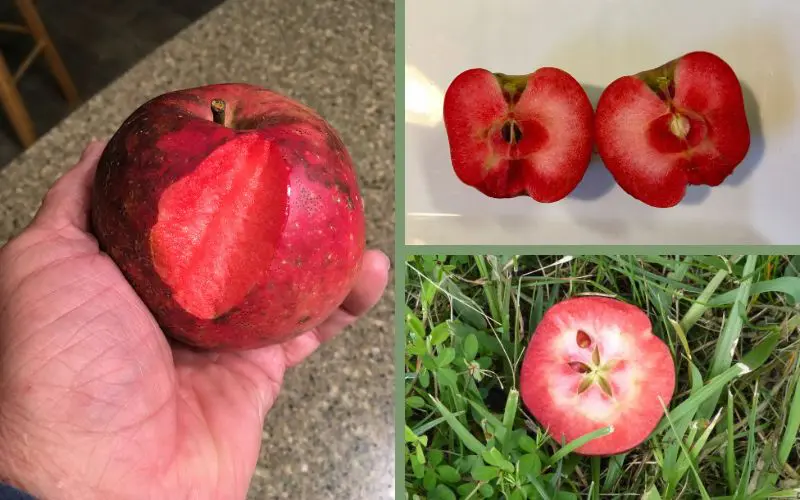
What are red-fleshed apples (and why do they look that way)?
Most apples are white or cream-coloured inside, so the first time you cut into a red-fleshed apple, it can feel like a surprise. The colour comes from natural plant compounds called anthocyanins, which are also found in foods like berries, cherries, and red cabbage.
These compounds are part of a broader group called polyphenols, which are naturally present in many fruits and vegetables. In apples, anthocyanins can appear in the skin, but in red-fleshed varieties, they also develop in the flesh itself.
Not all red-fleshed apples are equally vibrant. Some are lightly pink, while others are deeply coloured throughout. That variation depends on the variety, but also on growing conditions like temperature and sunlight.
Jonathan’s discovery and what he began to explore
Jonathan Griffith didn’t set out to study apples. He was working as a research scientist when he began dealing with serious digestive issues. One day, he picked up an apple at a local farm stand late in the season. When he bit into it, the deep red juice caught him off guard—but what stayed with him was how he felt afterward. His symptoms seemed to settle, at least for that moment. That experience sparked his curiosity.
Rather than assuming anything, he brought the apple back to his lab and began analyzing it. His work led him to focus on polyphenols, including anthocyanins and related compounds, and how they behave in the body. Some of these compounds are more easily absorbed, while others interact more directly in the digestive system.
Some red-fleshed apples contained higher levels of these compounds, while others did not. And even within a single variety, growing conditions could influence what developed inside the fruit.
Derek’s orchard and why apple diversity matters
As Jonathan searched for more samples to study, he ran into a problem. Red-fleshed apples aren’t widely available, especially in large numbers of different varieties.
That search eventually led him to Derek Mills.
Derek’s orchard in Ohio isn’t typical. He grows around 1,900 apple varieties, including more than 270 red-fleshed types. His focus isn’t commercial production—it’s preservation, curiosity, and a love of apple history.
He often points out that a small number of apple varieties dominate grocery stores today. Over time, apples have been selected for consistency, storage life, and appearance. While that makes sense for large-scale production, it also means many unique varieties have faded from view.
In Derek’s orchard, those varieties are still alive. Some are easy to grow. Others are difficult, inconsistent, or short-lived. But together, they offer a much broader picture of what apples can be.

Why growing conditions can change what’s inside the fruit
One of the most interesting things Derek has observed is how much apples can change from year to year.
In cooler seasons, some red-fleshed apples develop deeper colour. In warmer or drier conditions, that colour may be lighter. The same variety can taste quite different depending on when it’s harvested and what kind of season it had.
These changes aren’t just cosmetic.
Environmental factors like temperature, water availability, and soil conditions all influence how a tree grows and how fruit develops. If you’ve ever wondered why apples from your own tree taste different from one year to the next, this is a big part of the reason.
Recommended red-fleshed apple varieties to try
If you’re thinking about growing red-fleshed apples, Derek suggests starting with varieties that are both interesting and relatively reliable.
One standout is Red Devil, a variety developed in England. It ripens early and has a distinctive flavour that some people describe as berry-like or even reminiscent of strawberries.

Another well-known variety is Pink Pearl, which has a softer pink interior and a tart flavour. It can be more challenging to grow in humid climates, but it’s widely available and often a good introduction to red-fleshed apples.
Rubaiyat is another variety that has drawn attention, both for its colour and flavour, although like many red-fleshed apples, its performance can vary depending on conditions.
Some older or more wild-type varieties, like those descended from apples originally found in Kazakhstan, can be quite tart but are excellent for cider and juice.
If you’re sourcing trees, it’s worth asking nurseries or growers what performs well in your region. And if possible, tasting before planting can give you a better sense of what you enjoy.

Another important factor is timing. Ripeness isn’t just a small detail—it’s part of the entire experience, shaping both flavor and texture in ways that can be surprisingly dramatic.
Some apples change dramatically depending on when they’re picked. Derek describes tasting a variety early in the season and finding it unremarkable—only to try it weeks later and discover a completely different flavor.
What do red-fleshed apples taste like (and how can you use them)?
Flavour is one of the biggest surprises with these apples.
Many are tart, especially when eaten fresh, but they often have complex flavours that make them excellent for cooking and processing. Some lean toward berry-like notes, while others are sharp and refreshing.
They’re particularly well suited for:
- Applesauce with a natural pink hue
- Fresh juice or cider
- Baking, where their colour can add visual interest
Derek recalls making cider from red-fleshed apples that sold out quickly, partly because of the flavour and partly because of the striking colour.
If you’re curious how these flavours compare to more familiar apples, you might enjoy exploring a broader apple taste comparison to see where your preferences fall.
How to grow red-fleshed apples successfully
Growing red-fleshed apples isn’t very different from growing other apple trees, but success depends on matching the tree to your conditions.
One key factor is rootstock, which determines the size and resilience of the tree. In Derek’s orchard, he often uses M111 rootstock because it performs well in his clay soil and provides strong anchoring.
But what works in one location won’t necessarily work in another.
When choosing a tree, it’s important to consider your climate, soil type, and available space. If you’re just getting started, a guide to choosing fruit trees for your region can help you find varieties that are more likely to thrive.
Final reflection
For most of us, apples are about flavour, texture, and how well they grow in our climate. But talking to Jonathan and Derek opened up a different perspective. Jonathan, through his work with Palmetto Nutraceuticals, is looking closely at the compounds in red-fleshed apples and how they might function in the body. Derek is exploring that same question in his orchard, growing a wide range of varieties and watching how they change from year to year depending on conditions.
For home growers, that creates a really interesting opportunity. You don’t have to stick with the standard grocery store varieties. You can grow something unusual, taste it at different stages, and experiment with it in your kitchen, whether that’s fresh eating, juice, cider, or cooking.
Jonathan hopes more people will start doing exactly that. He sees red-fleshed apples as something we’ve largely overlooked, and he encourages growers to plant them, use them, and explore their potential—not just for their striking colour and flavour, but also for what they might offer from a health perspective.

There’s still a lot we don’t know, and the research is ongoing. But whether these apples turn out to be an unsung superfood or simply a fascinating group of diverse varieties, they invite us to look a little closer and stay curious.
Note: Research into plant compounds like anthocyanins is ongoing. This article shares insights from growers and researchers, but it is not intended as health/medical guidance.
Grow
Fruit Trees
That Thrive
Fruit Trees
That Thrive
Sign up for our newsletter and get this free eBook
Sign up for our newsletter and get this free eBook

Susan Poizner
Award-winning author, podcaster, fruit tree care educator and creator of the fruit tree care education website OrchardPeople.com. Learn more about Susan on the about us page.
YOU MAY ALSO BE INTERESTED IN
Best Fruit Trees to Grow: Choosing the Right Trees for Your Climate (Warm, Cold & Tropical)
Let The Sunshine In: Indoor Lemon Tree Care
If you live in a cold climate, growing a lemon tree indoors is still possible. Learn how in this article.

A Superfood in your Garden: How to Grow Seabuckthorn Plants
Learn how to grow nutrient-rich Seabuckthorn berries with plant breeder Bill Schroeder of Agriculture and Agri-Food Canada.

Bush Cherry vs Dwarf Cherry Tree: Best Picks for Your Small Garden
Dwarf cherry tree, or cherry shrub: which is a better choice for your small garden?